The Road to North Macedonia’s Accession to the EU
Jul 22, 2022
The road to the accession of North Macedonia to the European Union is inevitable. The only question is which path will lead us there faster.
ILPP is considered one of the important partners in the country in supporting the EU accession process.
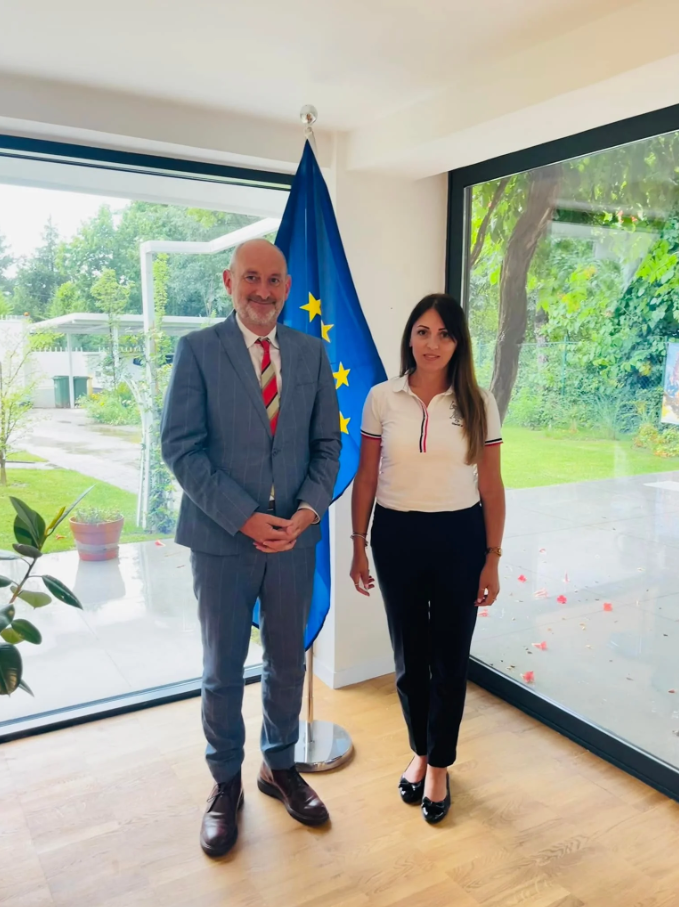
At the residence of the European Union in Skopje, among other policy-oriented civil society organizations from the country, the Institute attended a meeting hosted by the EU Ambassador, David Geer. During the meeting, we openly discussed the highly concerning situation related to the decision North Macedonia was about to make regarding the so-called “French Proposal” for lifting Bulgaria’s blockade on the country’s EU accession process. Pragmatic insights were shared by the Ambassador and EU institutional experts responsible for the EU enlargement of the Western Balkans, while questions and dilemmas raised by civil society organizations were addressed and widely discussed.
“From my point of view, the fundamentally important issue of the Macedonian language, when placed in this context, demonstrates a clear unanimity among all Macedonian citizens, regardless of their ethnic background.
The recent escalations, manifested either through organized protests by the largest opposition party or by individual citizens using various communication channels, clearly reveal the fragility of interethnic social cohesion. This poses a serious risk of damaging the good relations we have been investing in for several decades. Is this a luxury we can afford at this stage?
Most importantly, there is an uncertainty that manifests itself on two levels:
- First, uncertainty regarding the document itself and the mystifying nature of the ‘protocol,’ which has not been transparently opened for broad public discussion. This leaves room for skepticism and suspicion, fostering mistrust both within communities and between national and international actors. What happens next if we proceed and pass this step as it stands? What challenges will we face?
- Second, and more significantly, the uncertainty of what happens if we do not accept it. Undoubtedly, as uncertainty breeds fear, both fear and uncertainty are far more dominant in this second scenario compared to the already known reality: what happens if we reject this solution?
Considering the core political orientation of disputable ‘values’ promoted by the right-wing political party, which can reasonably be labeled as an east-oriented tendency, this scenario is unfortunately not entirely unpredictable.
None of us can guarantee that if the ‘French Proposal’ is rejected, there will not be a regression of two decades, nor that we will ever again be this close to EU accession and a pro-Western orientation as a country.”
— Pranvera Kasami